
Powerfully important work
Electrical Service
Reliable and affordable electricity to keep everything working
Additional Services
-
Street Light Service
$5.80/month
Electric Dos and Don't
History of the Manning Municipal Light Plant
It wasn’t until the late 1880’s that electricity was beginning to be produced for cities in Iowa. Manning residents were anxious to have this power also, but it wasn’t until 1901 that the first electric light franchise was issued to W.B. Swaney and Peter Ohrt for a period of 10 years. Some of the present plant and some of the distribution lines were built by Iowa Public Service Company at that time. The plant ran only when electricity was most needed by its customers. The $100,000 building was finished in 1928. It was a pressed brick structure trimmed with crus cone stone and adorned with ornamental windows. It was a building of which the city of Manning was proud. Two 400 horsepower oil engines furnished the city with its power needs for 13 years. Maurice Heider was the chief operator and Louis Suhr was the assistant.
The Manning Municipal Light Plant was started in August of 1927 when it bought out the Manning Electric Light and Power Company and IPS at the cost of $135,000. The board was comprised of R.G. Sutherland, O.W. Wyatt, and P.H. Jones with Sutherland as chairman. In 1938, the first full year of operation, there were 951,109 kilowatt hours sold. This increased to 4,966,938 kilowatt hours in 1959, and then to 13,469,297 in 1979. Additions needed to be made to the plant to accommodate the increase in usage, and the system kept updating.
In 1956 voters approved that the light plant purchase power from Northwest Iowa Power Cooperative and the Bureau of Reclamation. A 69,000-volt tie line and a substation at the light plant were built. The tie-in was made on June 10, 1957. The Bureau furnished the first 800 kilowatts used each month, and the local plant picked up the rest of the demand. In 1960, as the demand for power increased and more power became available from the Federal Bureau of Reclamation, the light plant stopped generation power on a firm basis and became a standby electric power generating facility for Manning.
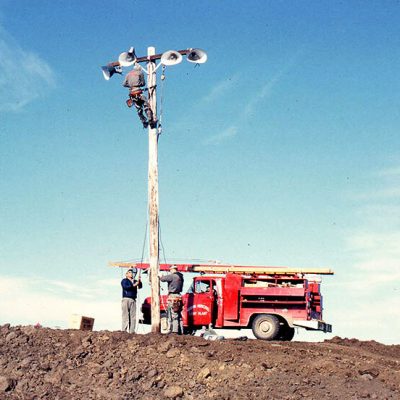
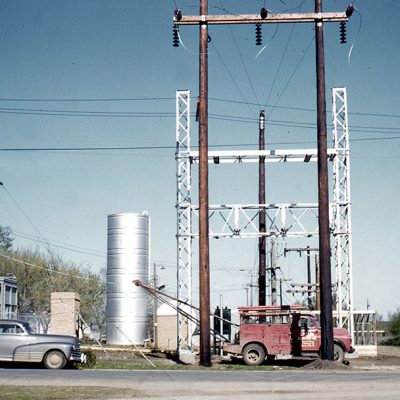
In 1965, the Manning Municipal Light Plant, through its trustees, joined with other municipal utilites, namely: Anthon, Aurelia, Hinton, Mapleton and Onawa to form Association (WIMECA) for the purpose of obtain additional low cost and reliable power. Manning was the prime mover for this project. In order for this goal to be accomplished, WIMECA had to become a Class A member of Northwest Iowa Power Cooperative (NIPCO). NIPCO members at that time were farmer owned electric power distribution organizations that delivered this power to individual farmers. By becoming a Class A member of NIPCO, WIMECA enjoyed the same rights and privileges, as well as obligations as NIPCO’s farmer owned cooperatives. All of these municipal utilities enjoyed rights to purchase power from the Federal Bureau of Reclamation. These rights were pooled into WIMECA for electric rate blending purposes. WIMECA in turned pooled them into NIPCO. Next, in order for WIMECA to meets in demands for power, it issued tax exempt bonds for this purpose of securing funds to purchase a share of power from a power generating station located the Missouri River known as George Neal No. 4. AT this point, the lenders who were to purchase these bonds wanted assurance that WIMECA was truly a lawfully organized legal cooperative entity under Iowa law since up to that point in time, no municipalities had banded together to form a cooperative organization under Iowa law. To properly address this point, WIMECA had to secure the passage of a legalizing act from the Iowa legislature to evidence that it was in fact a lawfully organized cooperative made of municipal utilities. This involved the joint efforts of legal counsel for the municipal utilities, WIMECA, NIPCO as well as bond counsel from law firms in Des Moines, Iowa, Omaha, Nebraska, and Chicago, Illinois. WIMECA is a very unique organization. There are very few like it in the United States.
As the demand for power increased, the Manning Municipal Light Plant made additions, replacements, and improvements to the system. In the 1970’s all electrical lines were moved underground. Manning was one of the first cities in Iowa to do this. It was also one of the first cities to have mercury vapor lighting in the business and residential areas. In the 1990’s these mercury lights were replaced in the business area with high pressured sodium lights. As street lights need replacing now, LED lights are installed, as they are more energy efficient.
To make the system more reliable and to meet the growing needs of AGP, a new electrical substation was built in 1992. A referendum was passed in 1996 to create a communications utility, MMCTSU, and this utility became a separate entity. The electric utility also installed the communications infrastructure in 1999.
By the early 2000’s 90 percent of the city’s distribution wires were underground. Up-to-date switching gear in the plant was installed, and upgrades to the light plant were done. These upgrades made the system more reliable and improved the ability of the switching system in times of outages. The original generators in Manning’s plant could still be utilized in case of an emergency. About one-fifth of the city could receive electricity from these at one time, and the system was set up to switch around to different parts of the city. Locations such as the hospital, school, Rec Center, and senior center could be served with electricity so that people could gather.
In 2010 Manning Municipal Light Plant teamed up with the USDA loan and grant program and was approved for a $250,000 revolving loan fund grant. This program has allowed Manning Municipal Utilities to loan money for developing and expansion of small businesses. It’s a self-replenishing pool of money, utilizing interest and principal payments on old loans to issue new ones. MMU continues to support and fund numerous area businesses.
In 2012 Manning’s new power plant was completed. It has a capacity of 6MW, which provides Manning Municipal Utilities with enough capacity to cover the loads of the community plus AGP during most times of the year should a transmission or substation outage occur. The new generation facility is located near the existing power plant and related substation, inside a new generation plant. The project was constructed in conjunction with replacement of the existing substation switchgear, and provides cost savings as compared to doing these projects separately.
In 2012 all of the highway lighting was replaced for improved safety and improvements were made in the city park for the lighting needs for the Christmas festival, Weihnachtsfest. Lighting has also been installed around the “Welcome to Manning” signs on Highway 141, the artwork along 141 by the little league fields and the lit structures that were placed on Main Street.
In 2020 Manning Municipal Utilities completed the trail light project. The utility employees worked with the City of Manning to install lighting along the new trail system in Manning City Limits.